
Hope dwindles for rescue in southwestern Japan quake as death toll climbs to 23

A search for survivors continued across Kumamoto in southwestern Japan on Thursday, two days after a magnitude-7.1 earthquake struck the region on Tuesday, leaving rescue teams with an increasingly urgent task. The disaster had killed at least 25 people, according to the report, and its effects reached beyond the first violent shaking: an explosion occurred at a shopping mall, a factory chimney collapsed, and homes were flattened. The reported toll put the human cost at the center of a disaster whose physical damage was evident in both residential communities and larger sites.
The central question on Thursday was whether anyone could still be reached alive. Rescue work was still under way in the Kumamoto area, where the quake hit on Kyushu, Japan’s southern main island. With two days already elapsed, the continuing operation carried both an immediate humanitarian purpose and a reminder that the window for finding survivors does not remain open indefinitely. The passage of time did not end the search, but it made the work more pressing for responders and for communities waiting for news.

Communities outside the region’s larger urban centers were trying to regain a sense of normality after the disaster. That effort was taking place against a landscape of severe damage and loss, rather than after a clean break from the emergency. The reported death toll, the destruction of homes and the hazards created at major sites showed that the earthquake had disrupted daily life on several levels at once. For those rural communities, the story was not limited to the moment of the quake; it also concerned the difficult transition from an active emergency toward whatever recovery could follow.
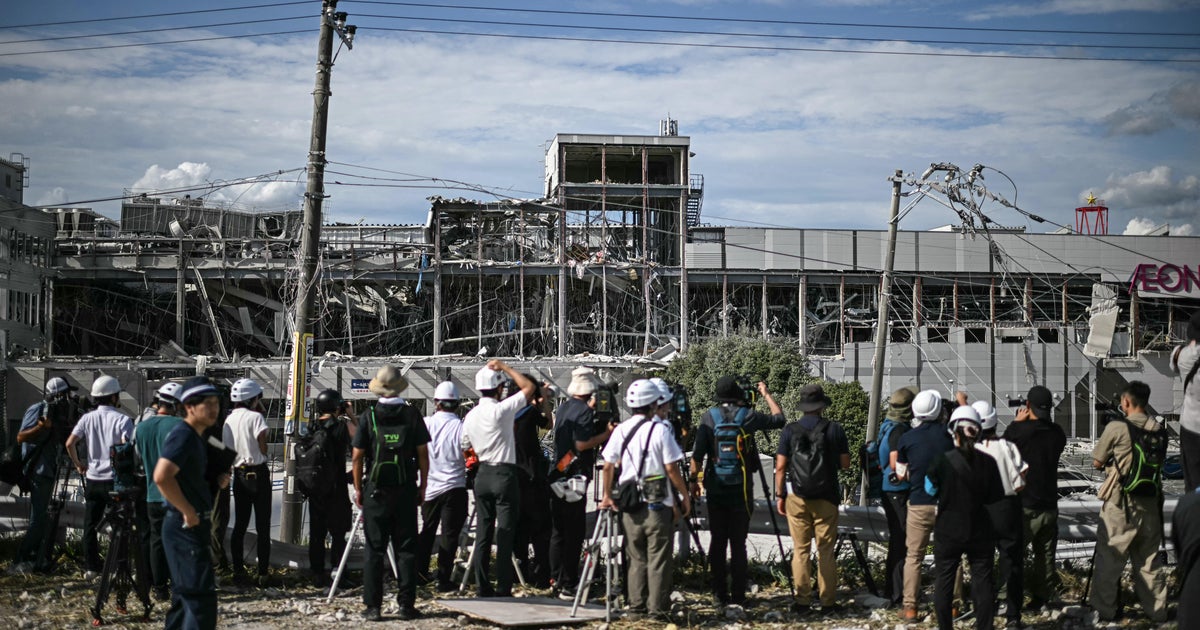
One of the most visible incidents was at AEON Mall Kumamoto in Kashima, in Kumamoto Prefecture. An explosion followed the earthquake there. A drone photograph made on Thursday showed responders working outside the mall, offering a view from above of an emergency scene that had become part of the wider response to the quake. The image placed the response at a recognizable public location, while also underscoring that the danger associated with the disaster was not confined to damaged homes.
The mall incident also illustrates why the aftermath could not be understood only as damage caused when the ground moved. The earthquake was followed by a separate dangerous event at a public commercial location. Elsewhere, the fall of a factory chimney and the collapse of houses pointed to different types of structural failure, each with consequences for the people living or working nearby. Taken together, those incidents gave the disaster a broader profile: rescuers and residents were dealing with loss of life, damaged housing and threats at places used for commerce or industry.
A magnitude of 7.1 describes a powerful earthquake, but the experiences recorded in this case were not uniform. In the account from Kumamoto, the effects ranged from an industrial structure coming down to residential destruction and an explosion at a mall. The combined picture was of an emergency spread across rural communities and significant facilities, not a single isolated incident. That distinction matters because the reported consequences were visible in several settings, each contributing to the scale of disruption faced across the affected area.
For residents, the search operation and the effort to restore ordinary life were unfolding at the same time. The recovery of routines depended on the immediate rescue phase, while the scale of the losses meant that a return to normal could not simply be assumed. The report described rural areas as struggling to get back on their feet, a measure of how the earthquake’s consequences persisted after Tuesday. The different kinds of damage also meant that the account of recovery would have to encompass people whose homes were destroyed as well as sites altered by the explosion and the collapsed chimney.
Thursday’s work therefore remained focused on what could still be learned and done at affected locations: whether survivors might be found, how damage at sites such as the mall would be addressed, and what the mounting loss of life meant for the communities involved. The available account establishes the scale of the shock and the ongoing rescue effort, but it does not provide a final account of survivors, damage or the longer recovery. That is the important caveat as the operation continues: the immediate facts document an unfolding emergency rather than a completed picture of its consequences.
Source: NPR World
Related articles
2 firefighters die in Greece as others fight massive blaze in France
Two firefighters died in a blaze on the Greek island of Crete Wednesday while crews in France confronted a wildfire four times the size of Paris, officials said.

Create AI images with your own API key
aixipi runs on desktop/web, uses your own model API balance, and avoids subscription lock-in.
Try aixipi →
Singer-songwriter Glen Hansard killed in motorcycle crash
Academy Award-winning Irish singer-songwriter Glen Hansard has died in a motorcycle crash.
Japan quake toll rises, people still missing in damaged mall and factory
The powerful earthquake that rocked southern Japan has killed at least 18 people and more remain missing in a damaged shopping mall and a paper factory.