
At least 16 dead when powerful 7.0 magnitude earthquake strikes Tibet
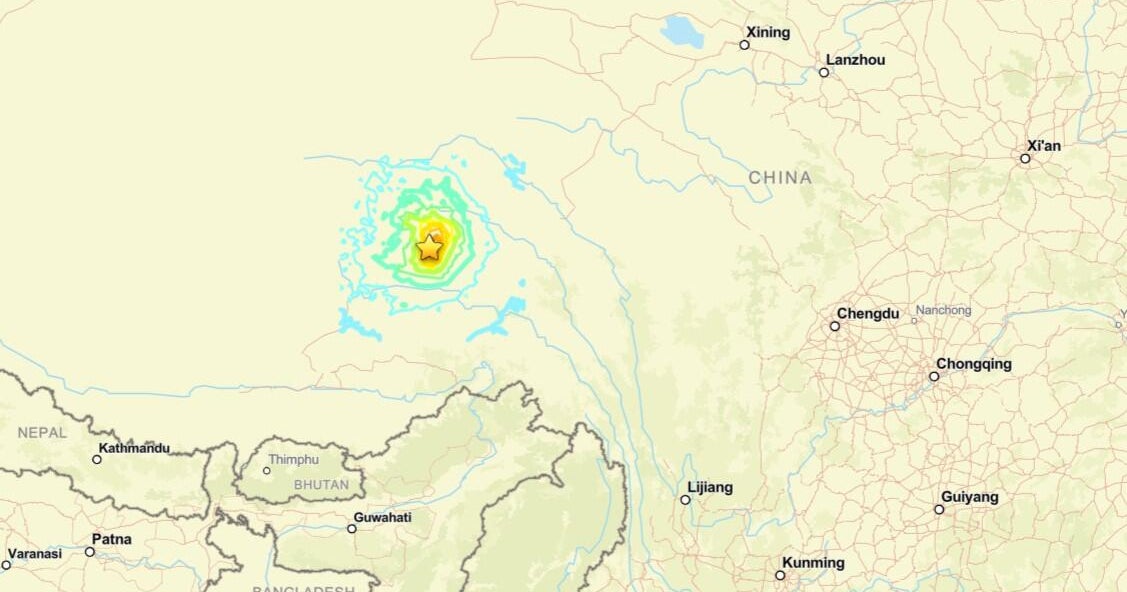
At least 16 people were killed after a 7.0-magnitude earthquake struck China’s Tibet region on Thursday night local time, according to Chinese state media. The tremor also left 46 people injured and damaged or destroyed hundreds of homes, local authorities said. The earthquake hit a remote part of northern Tibet, where communities are spread across a high-altitude landscape and recovery efforts can be complicated by distance, terrain and limited access.
The U.S. Geological Survey placed the earthquake at 10:33 p.m. local time. Its epicenter was estimated to be about 119 miles east-northeast of Nagqu, a city in northern Tibet. The location lies in a sparsely inhabited area, meaning the immediate population near the center of the quake may have been relatively small, though the damage reported by officials showed that settlements in the affected zone still sustained serious losses.
Chinese authorities said more than a dozen people had died, while state media later reported a toll of at least 16 fatalities. Forty-six people were reported hurt. The available information did not detail the severity of the injuries, the identities of those killed, or the condition of residents whose houses were damaged. Those figures could change as officials assess isolated communities and gather more complete reports from the earthquake zone.
Hundreds of homes were reported destroyed in the quake, underscoring the scale of the impact beyond the death and injury count. For families in the affected area, the loss of housing may create urgent needs for shelter and basic support, particularly after a nighttime earthquake. Authorities had not publicly provided a full breakdown of property damage, infrastructure conditions or the number of people displaced by the time the initial reports emerged.
The earthquake was described as the strongest to affect the region in five years. That comparison places the event among the most significant recent seismic incidents in Tibet, even as early reporting remained focused on casualties and destroyed homes. A magnitude 7.0 earthquake can be felt across a broad area, but the consequences in any location depend on factors including proximity to the source, local building conditions and the nature of the ground.
The remoteness of the epicenter is an important part of the developing story. Northern Tibet’s high elevation and widely separated settlements can make it harder to quickly establish the full extent of damage after a major tremor. Initial casualty figures often reflect only the locations that authorities can reach or contact first, leaving open the possibility that later assessments will provide a more detailed picture of losses across the surrounding area.
There was no immediate public account of whether rescue teams had reached every affected community, how many residents needed temporary accommodation, or whether roads and other essential links had been disrupted. Those questions will shape the next phase of the response. Officials will also need to determine the condition of homes that remain standing, since structures weakened by an initial earthquake can pose risks even when they have not collapsed.
For now, the confirmed picture is one of a powerful late-night earthquake with a deadly human toll, dozens of injuries and extensive housing damage in a lightly populated part of Tibet. The difference between the confirmed figures and the broader unknowns remains significant: the reported deaths and injuries establish the seriousness of the event, while the final scope of damage and humanitarian needs will depend on further assessments in the days ahead.
Source: CBS World
Related articles
Zelenskyy accuses Russia of using cluster warheads in deadly strikes
Russia launched the strikes on Ukraine less than a day after negotiations to end the war, which also involved the United States, ended in St. Petersburg.

Create AI images with your own API key
aixipi runs on desktop/web, uses your own model API balance, and avoids subscription lock-in.
Try aixipi →
See how Big Tech is transforming Spain's landscape
A drought-stricken region of northeast Spain has become a focus for American companies searching for locations to place their data centers.

Bukele says military operation launched to rescue Salvadorans held by gangs in Haiti
El Salvador's President Nayib Bukele said Wednesday he had launched a military operation to rescue four Salvadoran aviation technicians kidnapped by gangs in Haiti.