
A Herd of 40 Life-Size Bison Puppets Will Stampede Through New York This Weekend to Honor Indigenous History and Resilience
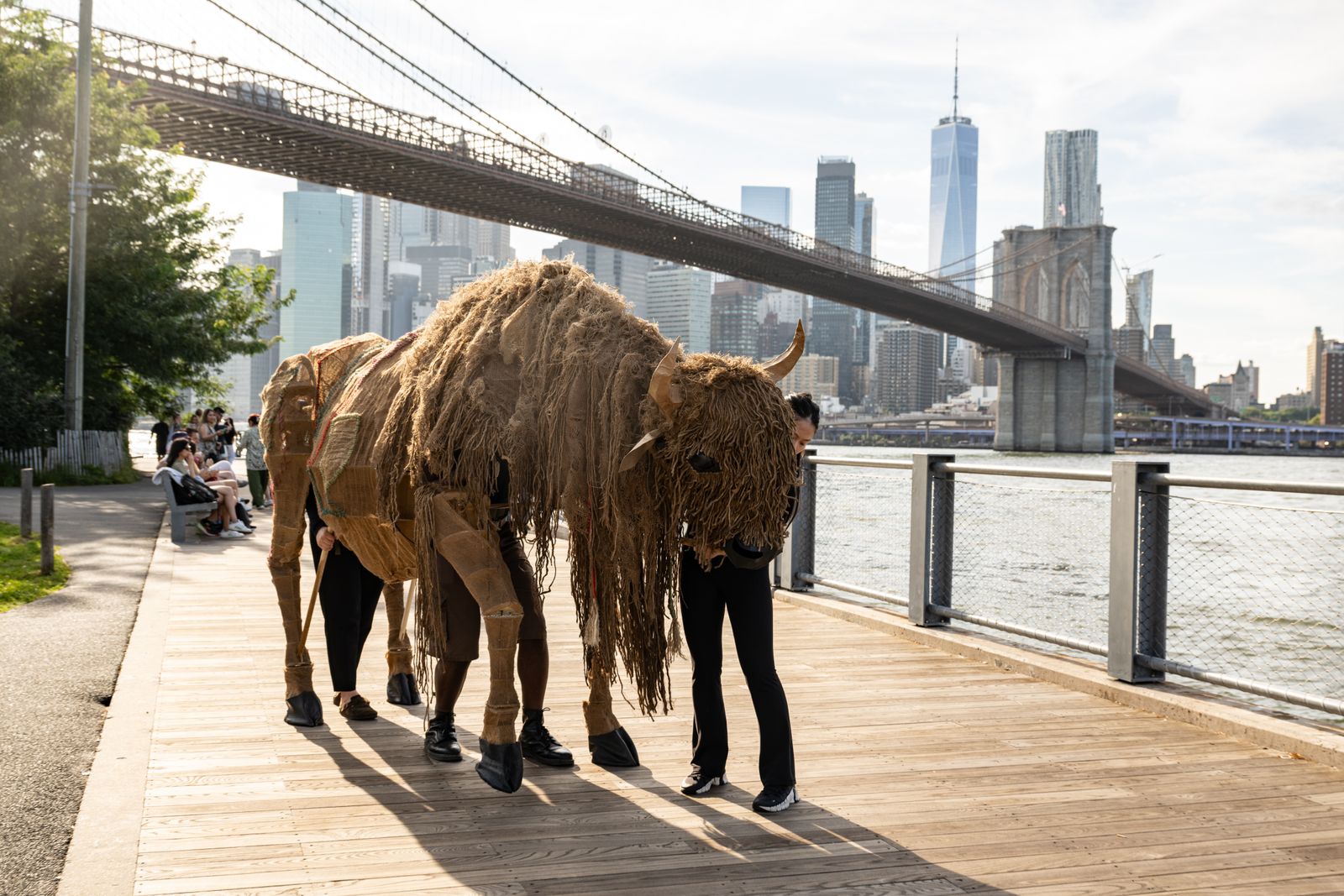
This weekend, New York City streets are set to become the stage for an unusually large moving artwork: 40 full-scale bison puppets. The herd will travel through Lower Manhattan and Brooklyn in a free, two-day presentation called Return of the Buffalo: Tatanka Owe Akupi. Rather than treating the animals as a backdrop, the event places their history and the enduring relationship between bison and Indigenous communities at the center of a public encounter.
The puppets are designed at life size, giving the procession the visual scale of a herd rather than a conventional parade float. Each animal needs three people to operate it. Before the public performances, the puppeteers spent several days learning the coordinated motions and cues needed to make the bison move together. That preparation will allow a large group of constructed animals to navigate dense city blocks as a single, choreographed presence.
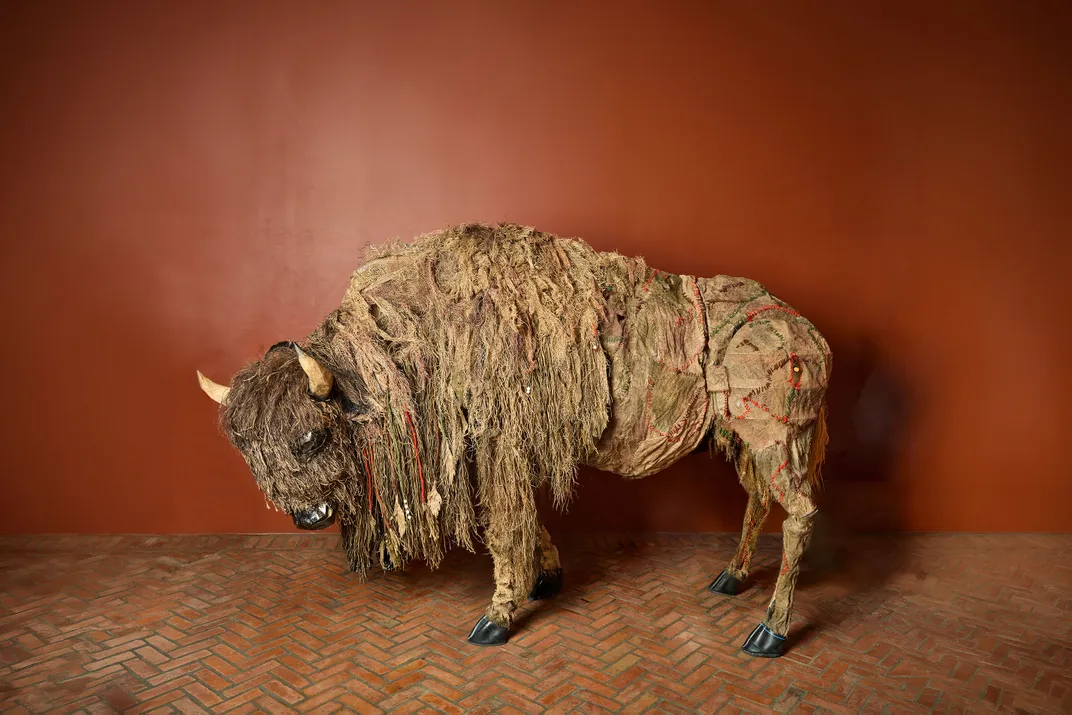
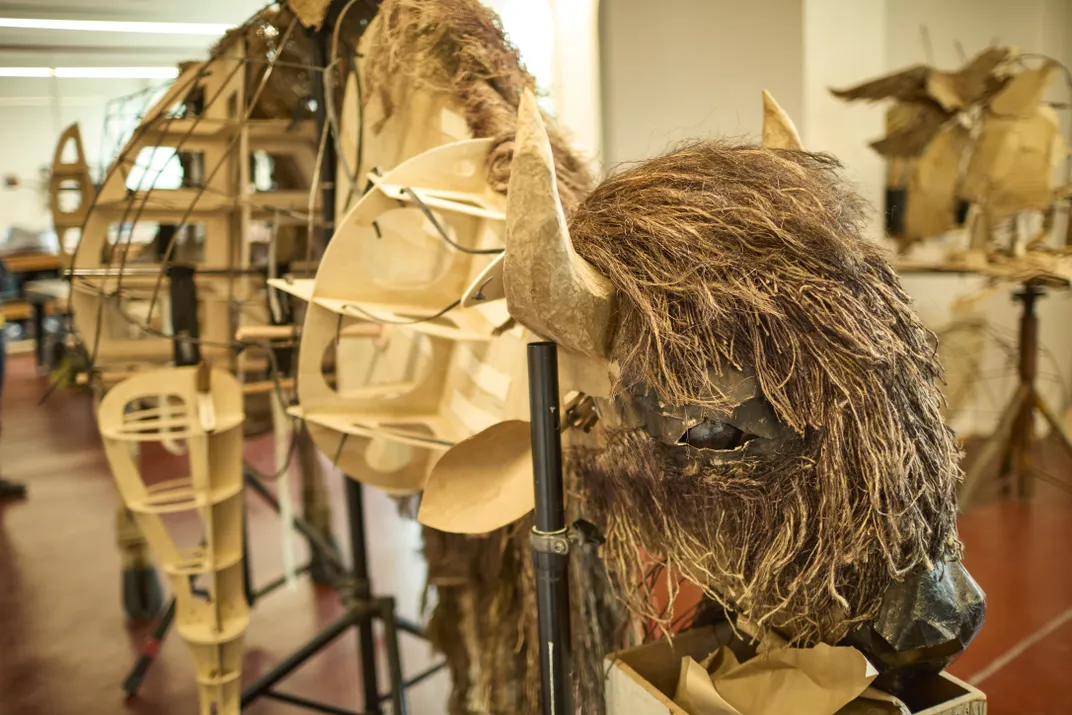
The bison figures were made during the summer from steel, plywood, burlap and paper. Those materials underline the project’s theatrical character: the animals are handmade objects, yet their size and collective movement are intended to suggest the force of a living herd. By taking that image into the city, the production turns sidewalks and streets into a setting for a story more often associated with the grasslands of the American prairie.
The program’s Lakota title is approximately rendered in English as “Trail of the Buffalo.” Its name points to a narrative that reaches beyond the weekend spectacle. Organizers frame the presentation around bison as animals held in deep regard by Indigenous peoples, including communities that have cared for and managed their herds across generations. The event also recognizes Indigenous resilience alongside the animal’s own difficult history.
That history includes a severe collapse in bison numbers toward the end of the 19th century, when the species came close to disappearing. The exhibition follows the longer arc from that near-loss to the gradual return of bison populations across prairie landscapes. The emphasis on recovery does not erase the earlier devastation; instead, it gives the procession a historical frame in which survival, stewardship and renewal are linked.
New York audiences will see the work on two distinct journeys rather than along a single route. One procession is planned for Lower Manhattan, while the other will take place in Brooklyn. The split itinerary brings the project to neighborhoods with different streetscapes and crowds, while keeping the bison’s movement through the city itself as the principal visual event. It also makes the artwork accessible as an encounter in public space rather than an installation confined to one venue.
The roving puppets will not be the program’s only element. Poetry, live musical performances, ceremonial activity and dance are also scheduled during the two days. Together, those forms are meant to supply context for the animals’ place in both the history of the United States and the histories that preceded it. The format makes room for performance and reflection, instead of presenting the bison solely as an arresting visual attraction.
A street event of this kind necessarily leaves some of its meaning to the audience. The handmade herd may be read first as a feat of puppetry, while the accompanying artistic and ceremonial program asks viewers to consider the larger cultural and historical account behind it. The difference matters: a dramatic city procession can draw attention, but the project’s stated purpose extends to Indigenous memory, care for bison and the consequences of their near-erasure.
What follows after the weekend is not another announced chapter in the exhibition, but the themes it puts before passersby remain broader than its two routes. The bison’s path from devastation toward repopulation continues to shape how the animal is understood, and the event presents Indigenous stewardship as inseparable from that story. For spectators, the immediate thing to watch will be a carefully trained team animating 40 towering figures; the larger message is the history carried with them.
Source: Smithsonian Magazine
Related articles
Immerse Yourself in the Cosmos at Frank Lloyd Wright's Only Planetarium, Recently Restored to Its Former Glory in Florida
Completed in 1958, the domed building is located on the campus of Florida Southern College, home to 13 Wright-designed buildings, the world's largest single-site collection of the architect's work

Play Tractor online with friends — free
Real-time Sheng Ji / Tractor for 3–5 players, with complete bidding and trump rules across web, iOS and Android.
Play bidfive →
A Team of Astronomers Thinks They Have Identified the Exact Night Sky That Inspired Vincent van Gogh's 'Starry Night.' Not Everyone Is Convinced
Very few night skies seen from the south of France during the summer of 1889 would match the scene on van Gogh's canvas. A new study argues that it could have been July 22

'Pretty Boy' Floyd, One of the Most Notorious Outlaws of the Great Depression, Was Shot and Killed in an FBI Raid 92 Years Ago
Some Americans lauded the 30-year-old bank robber as a Robin Hood-esque folk hero. Others castigated him as a violent criminal whose misdeeds were emblematic of the troubled era

GTA 6 guides, updates and practical reference
Explore a Chinese GTA 6 guide library covering the release, map, characters, missions, vehicles and weapons.
Browse guides →
Create AI images with your own API key
aixipi runs on desktop/web, uses your own model API balance, and avoids subscription lock-in.
Try aixipi →