
A Team of Astronomers Thinks They Have Identified the Exact Night Sky That Inspired Vincent van Gogh's 'Starry Night.' Not Everyone Is Convinced
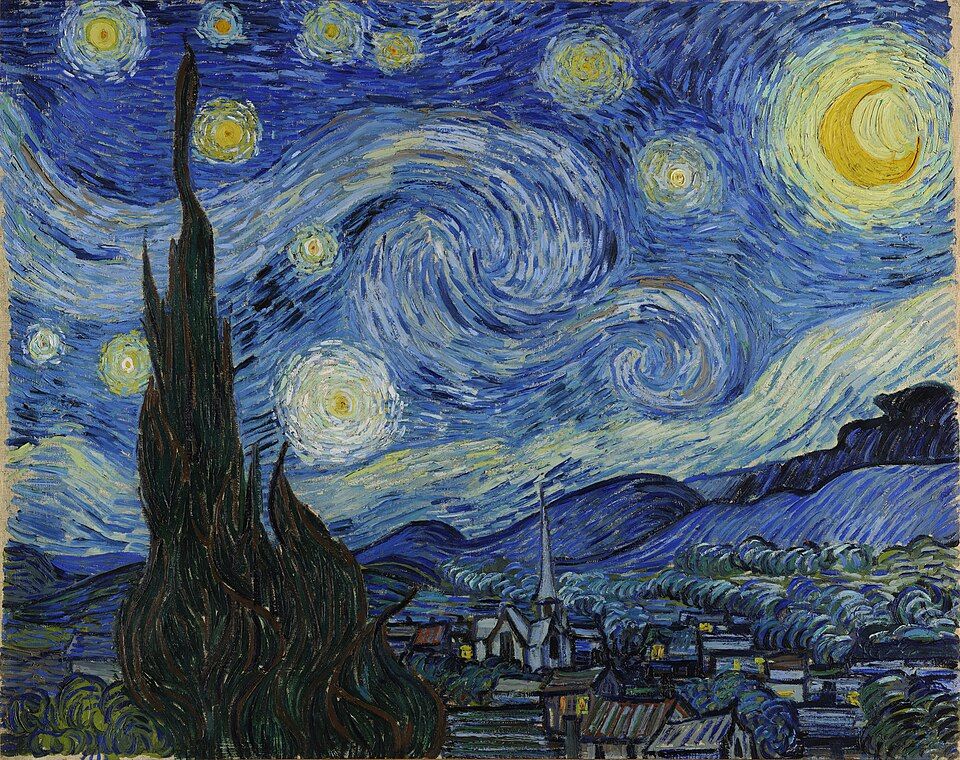
A group of South Korean astronomers says it may have narrowed the inspiration for Vincent van Gogh’s The Starry Night to a single dawn: July 22, 1889. Their conclusion, published in Scientific Reports, challenges the long-standing view that the celebrated canvas was painted in June of that year. Museum experts and other scholars, however, caution that the proposal remains a theory rather than a final answer.
The painting emerged during van Gogh’s stay at an asylum in Saint-Rémy-de-Provence in southern France. At 36, he was recovering after a series of mental-health crises, and the view from his room became an important source of observation. In correspondence with his brother Theo from early June, van Gogh described looking out before daylight and seeing a strikingly large morning star. Later that month, he told Theo that he had made a study of a night sky.
Those letters, alongside other records from the period, have long led art historians to associate The Starry Night with June 1889. The new research does not argue that van Gogh’s June observations were irrelevant. Instead, its authors suggest he may have developed the idea then and finished the work after a later celestial display, roughly a month afterward.
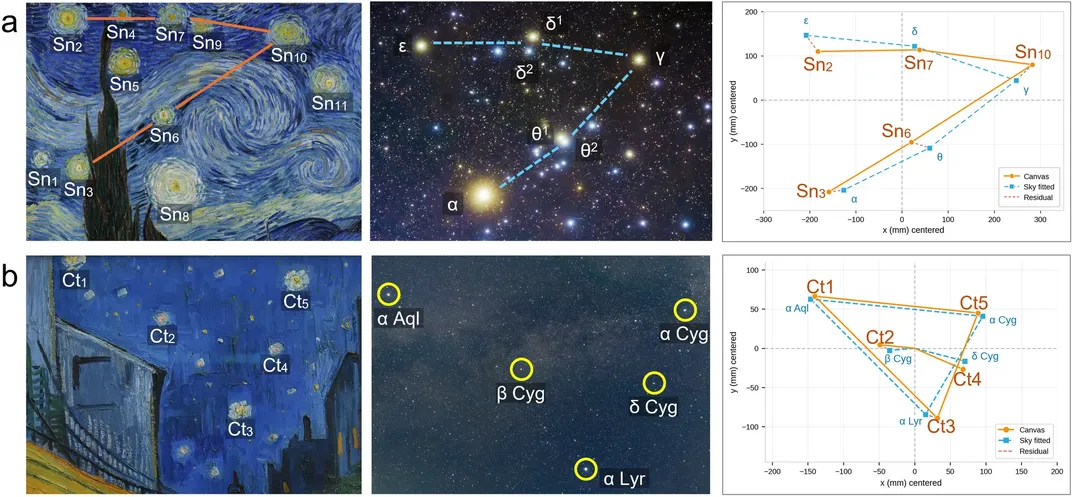
The researchers approached the painting as a possible record of an actual sky rather than a wholly invented arrangement. They used astronomy software to reconstruct the skies above Saint-Rémy for every night in June and July 1889. Their comparison focused on the spatial relationship among the painting’s main astronomical elements: the stars, the crescent moon and Venus. Color and apparent scale were set aside because an artist could have altered those features.
According to the study, the strongest match involved the Hyades, a V-shaped group of five stars in Taurus. The team concluded that this formation corresponded better with the painted stars than Aries, which previous analyses had proposed as the work’s dominant constellation. The researchers argued that Aries would have appeared relatively dim at the early-morning hour when van Gogh was known to work.
July 22 was the only date in the team’s reconstruction that met all of its chosen conditions. On that morning, the moon was a crescent positioned above Venus, while the Hyades could fit within the composition’s field of view. A weather review also indicated clear conditions suitable for seeing stars. Lead researcher Elijah Jeong-hyun Kim, a telescope-company chief executive and astronomy doctoral candidate at Kyung Hee University, has said he regards that date as the stronger explanation.
The claim adds another layer to a painting often discussed for its emotional force and swirling, expressive forms. It also raises a broader question about how closely van Gogh observed nature while transforming it on canvas. An independent physicist, Jose Luis Aragon of the National Autonomous University of Mexico, described the July proposal as an “intriguing hypothesis” rather than a settled conclusion, while saying the work showed close attention to the real sky.
The Van Gogh Museum in Amsterdam has taken a more skeptical position. A museum spokesperson said van Gogh did not aim for exact visual replication, meaning the locations of celestial objects may not provide a dependable way to date the painting. The museum also noted that van Gogh experienced a serious breakdown around July 22 and was unable to paint for approximately a month afterward, a complication for the new timeline.
The disagreement leaves the dating question open. The astronomical analysis offers a precise candidate for the scene behind one of art’s most recognizable images, but it relies on the premise that van Gogh preserved the sky’s arrangement closely enough for modern reconstruction. Future discussion is likely to turn on how much weight should be given to celestial calculations, letters, medical history and the artist’s freedom to reshape what he saw.
Source: Smithsonian Magazine
Related articles
Immerse Yourself in the Cosmos at Frank Lloyd Wright's Only Planetarium, Recently Restored to Its Former Glory in Florida
Completed in 1958, the domed building is located on the campus of Florida Southern College, home to 13 Wright-designed buildings, the world's largest single-site collection of the architect's work

Play Tractor online with friends — free
Real-time Sheng Ji / Tractor for 3–5 players, with complete bidding and trump rules across web, iOS and Android.
Play bidfive →
'Pretty Boy' Floyd, One of the Most Notorious Outlaws of the Great Depression, Was Shot and Killed in an FBI Raid 92 Years Ago
Some Americans lauded the 30-year-old bank robber as a Robin Hood-esque folk hero. Others castigated him as a violent criminal whose misdeeds were emblematic of the troubled era
The Canadian Artist Jean Paul Riopelle Was 'Completely Absorbed by the Act of Painting.' His Abstract Works Finally Have Their Own Home in a Quebec Museum
Home to the world’s largest public collection of his artworks, a new pavilion at Quebec's Musée National des Beaux-Arts showcases the more than 50-year career of Riopelle, who was a key member of the avant-garde Automatistes movement

GTA 6 guides, updates and practical reference
Explore a Chinese GTA 6 guide library covering the release, map, characters, missions, vehicles and weapons.
Browse guides →
Create AI images with your own API key
aixipi runs on desktop/web, uses your own model API balance, and avoids subscription lock-in.
Try aixipi →