
Humpback whale seen grieving dead calf in rare footage
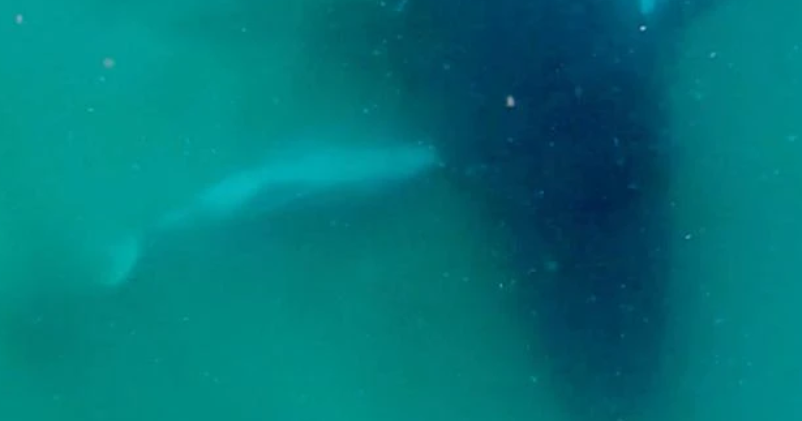
A female humpback whale was filmed lingering beside a calf that appeared to have been stillborn, a sequence described in research released Wednesday as an unusual window into how whales respond after a loss. The images were recorded off Australia’s Gold Coast last year and show the adult remaining near the young whale after it had settled without movement on the seabed. The footage has brought an otherwise private moment beneath the water into unusually clear view.
In the video, the mother’s attention does not appear to shift away from the calf. She moves close enough to make contact, using her head and a fin against the smaller animal. A second whale is also present during the encounter, adding another dimension to footage researchers have described as rare. Together, the animals remain close to the motionless calf on the sea floor.
The scene has drawn attention because it captures what appears to be a sustained response rather than a fleeting encounter in open water. The calf is shown resting on the ocean bottom, while the adult stays nearby. The female is also seen looking toward the animal, behavior the researchers describe as apparent grieving. Her contact with the calf is a central part of the record.
That wording is significant. Video can show an animal’s movements, proximity and interactions, but it cannot directly prove an internal emotional state. The research therefore presents a behavioral observation involving a dead calf, rather than a conclusive measurement of the whale’s feelings. Describing the event as apparent grief acknowledges both the striking nature of the images and the limits of what can be known from them.
The study identifies the calf as stillborn, distinguishing the episode from an ordinary separation between a mother and a growing young whale. It places the adult’s actions in the context of a death and documents physical contact after the calf had become still. The location of the calf on the seabed, along with the mother’s decision to remain near it, gives the footage its particular weight.
Whale behavior is often difficult for people to witness in detail, especially when interactions take place below the surface and away from shore. In this case, the recording preserves features that could easily have gone unseen: the calf’s position, the mother’s repeated closeness, contact made with her head and fin, and the presence of another humpback. Those visible details give researchers material for closer examination.
The companion’s role is not established by the footage. Its presence shows that the mother and calf were not alone, but the available account does not say why the second whale stayed nearby or whether it interacted directly with the dead calf. That uncertainty is important, because the video records a particular episode rather than providing a complete explanation of every animal’s behavior.
The research also cannot answer how often humpback whales show comparable responses after a calf dies. A single documented event cannot establish whether similar behavior is widespread, how long it might continue, or whether mothers respond in the same manner under different circumstances. Still, the recording creates a reference point for scientists who may encounter and compare future observations.
For researchers studying animal behavior, the distinction between description and interpretation remains important. Human emotional language can help convey why a scene matters, but it can also imply more certainty than an observation supports. The clearest record is that a female humpback remained beside her dead newborn, looked toward it, and touched it while another whale was present. Further footage may help show whether those actions follow a broader pattern.
Source: CBS World
Related articles

Zelenskyy accuses Russia of using cluster warheads in deadly strikes
Russia launched the strikes on Ukraine less than a day after negotiations to end the war, which also involved the United States, ended in St. Petersburg.

Create AI images with your own API key
aixipi runs on desktop/web, uses your own model API balance, and avoids subscription lock-in.
Try aixipi →
At least 16 dead when powerful 7.0 magnitude earthquake strikes Tibet
It was the biggest earthquake in the region in the last five years, China

See how Big Tech is transforming Spain's landscape
A drought-stricken region of northeast Spain has become a focus for American companies searching for locations to place their data centers.