
In a First, Astronomers Identify a Star That Might Glow Green. New Research Highlights the Strange Hues White Dwarfs Can Take on
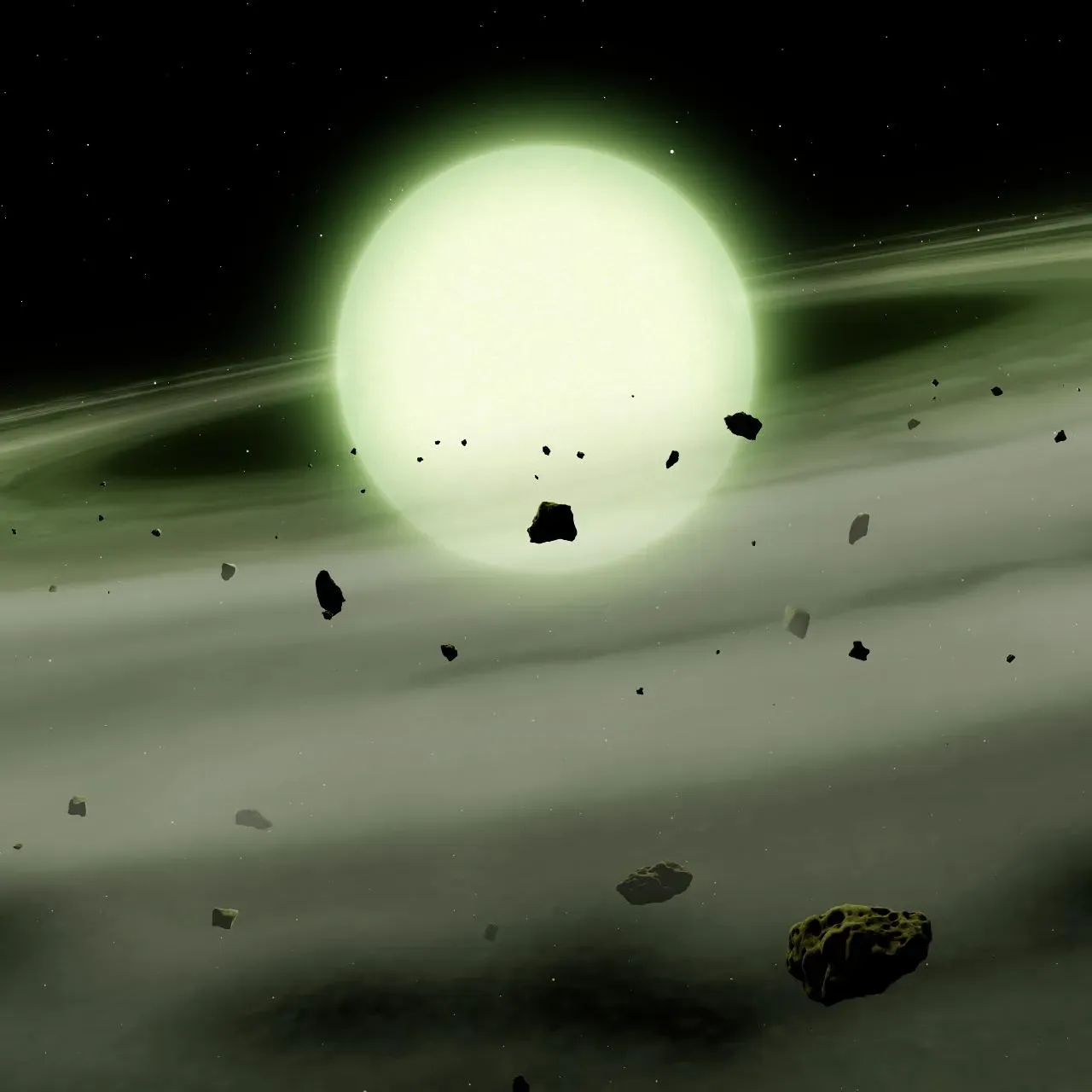
A white dwarf about 280 light-years away may look unlike the familiar blue, white and orange stars of the night sky. Researchers say the stellar remnant known as WD J1330+6435 could present a chartreuse, greenish-yellow color when its emitted light is translated into the range visible to human eyes. The result marks an unusual case in an effort to determine how white dwarfs might appear if their light could be viewed more directly.
The work, published October 15 in RAS Techniques and Instruments, links that possible tint to material gathered from the object’s own planetary neighborhood. WD J1330+6435 appears to have taken in rocky debris, leaving detectable calcium, lithium and sodium in its outer atmosphere. Those added elements alter the pattern of light coming from the star, producing a color that would be highly unusual among stars.
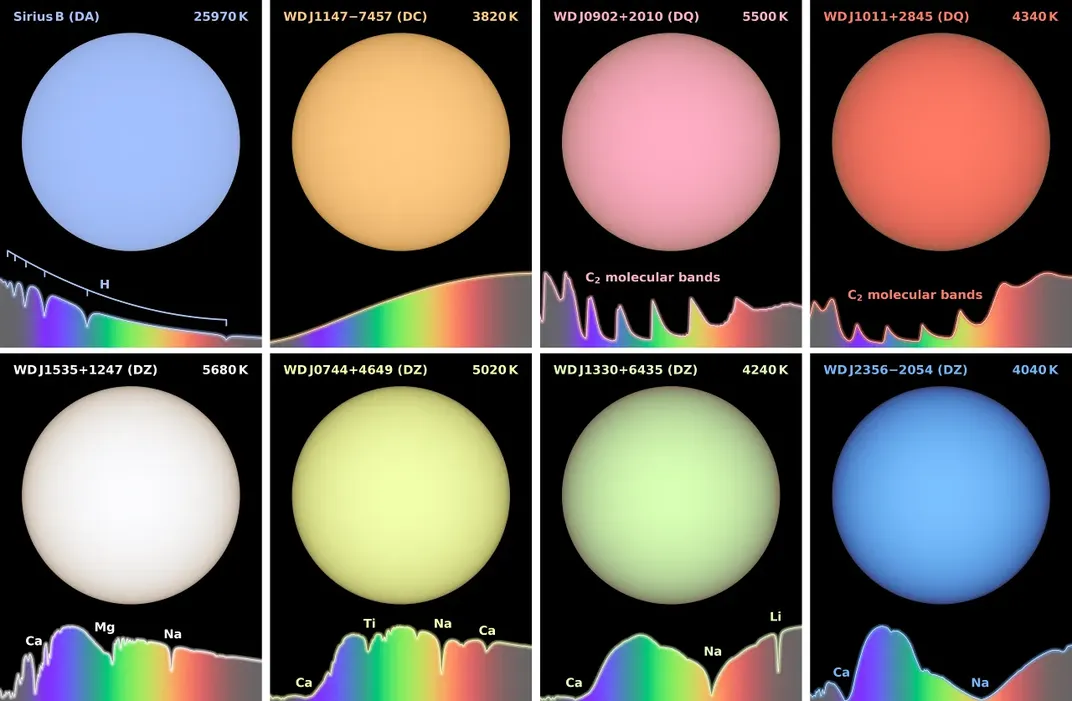
White dwarfs are not generally close enough for observers to see their disks and colors as they might see nearby planets or the sun. Instead, astronomers measure the wavelengths arriving at Earth and use those measurements to reconstruct a likely visual appearance. Applying that approach to a collection of white dwarfs revealed more variety than their name suggests: some could appear yellow, pink or purple, while this object stands out as a candidate for a green-leaning shade.
Most stars remain confined to a much narrower visual palette. Mark Hollands, an astrophysicist at the University of Warwick and a co-author of the study, said ordinary stars are usually seen as orange, white or blue. He told CNN that white dwarfs commonly follow the same broad pattern, but exceptional conditions near their surfaces can reshape the spectrum enough to create much more conspicuous departures.
The finding turns on stellar chemistry rather than a simple labeling exercise. A star’s perceived color depends on the balance of wavelengths it emits, and an atmosphere containing unusual ingredients can modify that balance. In WD J1330+6435, the metals associated with rocky material provide a clue to both the object’s color and the processes affecting it. The study therefore connects an observable property—the modeled hue—to evidence of a disturbed or evolving planetary environment.
White dwarfs are the compact remains of stars, and their physical scale helps explain why their outer layers can produce distinctive effects. They commonly contain about half the mass of the sun even though their diameter is only modestly greater than Earth’s. Packing that much mass into such a small volume makes them roughly 200,000 times as dense as Earth, placing their atmospheres under conditions far removed from those around more typical stars.
That extremity is also a reason for caution in treating the result as a literal telescope portrait. The reported colors are reconstructions based on spectra, not direct images of a tiny disk resolved from Earth. “Green” in this case describes how the measured light may register to human vision after modeling, rather than an easily visible green point for a casual skywatcher. The result nonetheless gives a more intuitive way to describe spectral differences that instruments can measure.
The broader survey suggests that white dwarfs need not be assumed visually uniform simply because many resemble ordinary stars in their emitted light. Cases with altered outer-layer physics or atmospheric contamination may offer exceptions, each carrying information about what has happened around the remnant. A yellow, purple, pink or chartreuse reconstruction is not merely decorative: it can signal that the chemistry of the star’s atmosphere differs from the expected baseline.
Further observations and modeling will be needed to test how often such rare colors occur and which atmospheric ingredients produce them most strongly. For WD J1330+6435, the immediate implication is that material from a rocky planetary system has left a measurable mark on the star. As astronomers catalog additional white dwarfs and compare their spectra, they may be able to distinguish ordinary remnants from those whose light preserves traces of the worlds and debris surrounding them.
Source: Smithsonian Magazine
Related articles
Immerse Yourself in the Cosmos at Frank Lloyd Wright's Only Planetarium, Recently Restored to Its Former Glory in Florida
Completed in 1958, the domed building is located on the campus of Florida Southern College, home to 13 Wright-designed buildings, the world's largest single-site collection of the architect's work

Play Tractor online with friends — free
Real-time Sheng Ji / Tractor for 3–5 players, with complete bidding and trump rules across web, iOS and Android.
Play bidfive →
A Team of Astronomers Thinks They Have Identified the Exact Night Sky That Inspired Vincent van Gogh's 'Starry Night.' Not Everyone Is Convinced
Very few night skies seen from the south of France during the summer of 1889 would match the scene on van Gogh's canvas. A new study argues that it could have been July 22

'Pretty Boy' Floyd, One of the Most Notorious Outlaws of the Great Depression, Was Shot and Killed in an FBI Raid 92 Years Ago
Some Americans lauded the 30-year-old bank robber as a Robin Hood-esque folk hero. Others castigated him as a violent criminal whose misdeeds were emblematic of the troubled era

GTA 6 guides, updates and practical reference
Explore a Chinese GTA 6 guide library covering the release, map, characters, missions, vehicles and weapons.
Browse guides →
Create AI images with your own API key
aixipi runs on desktop/web, uses your own model API balance, and avoids subscription lock-in.
Try aixipi →