
Japan launches ambitious robotic mission to Martian moon Phobos
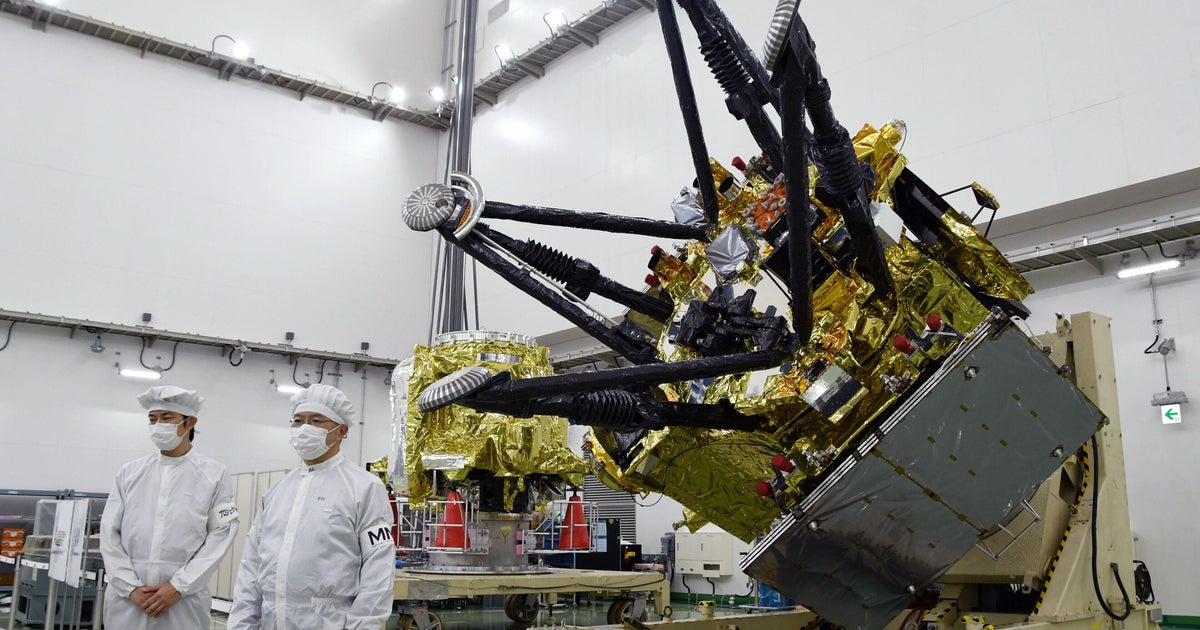
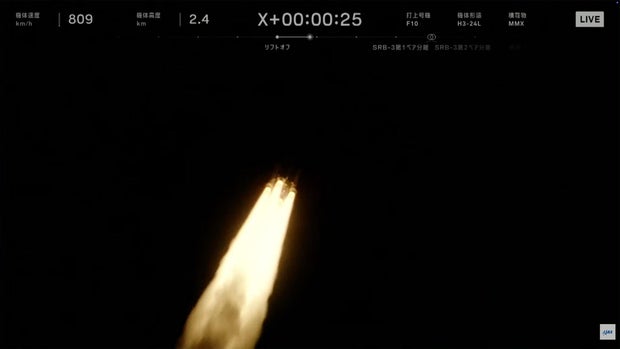
Japan has sent a robotic spacecraft toward Mars in a mission designed to examine the planet’s two small moons and bring material from the larger one, Phobos, back to Earth. The roughly $350 million Martian Moons Exploration, known as MMX, began its journey Monday. Its central scientific question is deceptively simple: where did Phobos and its companion, Deimos, come from? The mission therefore combines a close survey of two little-understood objects with an attempt to recover evidence that researchers can inspect directly on Earth.
The project will study both moons closely, but Phobos is the planned site of the mission’s most demanding work. Before the main spacecraft goes down to the surface, it is expected to deploy a compact rover. The orbiter-lander will then attempt to collect regolith, the loose material covering Phobos, using robotic equipment. Those samples are intended to make the return trip to Earth for examination. By pairing observations around Mars with material taken from Phobos, the mission is designed to build a fuller record than either approach could provide alone.
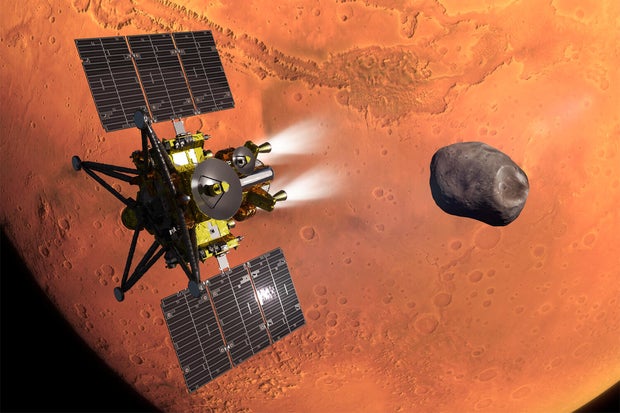
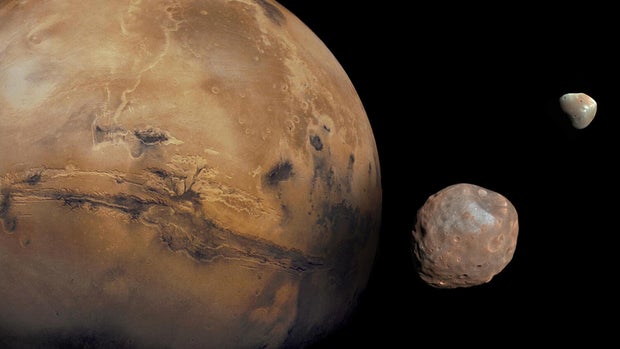
Scientists have long debated two competing explanations for the Martian moons. One possibility is that a major collision in the early history of the solar system produced debris that later formed the pair. The other is that they began as passing asteroids and were trapped by Mars’s gravitational pull. MMX is built to seek evidence that could distinguish between those origins rather than relying only on remote observations.
At first glance, Phobos and Deimos can look like asteroids, a resemblance that helps explain the capture theory. Both have uneven, non-spherical forms and are tiny beside Earth’s Moon. Phobos spans about 17 miles at its broadest point, while Deimos is under half as wide. Yet appearance and dimensions cannot, by themselves, settle whether the bodies arrived from elsewhere or were assembled from impact debris around Mars.
That limitation gives the sample-return portion of the mission particular importance. Material gathered directly from Phobos can be studied on Earth in far greater detail than images alone allow. Researchers will be looking for clues in the material that may connect it either to an asteroid-like history or to matter associated with a large ancient impact. A physical sample offers a chance to examine characteristics that cannot be fully resolved from a distance. The mission’s stated aim is not merely to visit a moon, but to turn that unresolved origin story into a testable scientific question.
The rover and landing sequence also underscore the challenge of working around such a small world. Phobos is far less massive than a planet, and its irregular shape makes it unlike the large, comparatively familiar bodies that have hosted many earlier surface missions. MMX must conduct its operations while preserving the collected material for the eventual journey home, making the return sample a central measure of the expedition’s value.
A successful investigation would matter beyond a single Martian moon. The answer could inform how scientists interpret the early solar system, including the roles played by collisions, wandering small bodies and planetary gravity. It could also improve understanding of Mars’s own past, because the histories of its moons are tied to the environment around the red planet. Still, the mission has been framed around resolving a question, not confirming a favored explanation; the evidence from Phobos may prove more complicated than either basic scenario.
For now, the launch starts a long scientific campaign rather than delivering a conclusion. The immediate milestones to watch are the detailed study of the two moons, the release of the small rover at Phobos, the spacecraft’s surface collection attempt and, ultimately, the arrival of the samples on Earth. Each step depends on the success of the one before it, while the final analysis will determine whether the mission can answer its central question. Only after that material can be analyzed will investigators be able to judge which account of Phobos and Deimos has the stronger support.
Source: CBS World
Related articles

Zelenskyy accuses Russia of using cluster warheads in deadly strikes
Russia launched the strikes on Ukraine less than a day after negotiations to end the war, which also involved the United States, ended in St. Petersburg.

Create AI images with your own API key
aixipi runs on desktop/web, uses your own model API balance, and avoids subscription lock-in.
Try aixipi →
At least 16 dead when powerful 7.0 magnitude earthquake strikes Tibet
It was the biggest earthquake in the region in the last five years, China

See how Big Tech is transforming Spain's landscape
A drought-stricken region of northeast Spain has become a focus for American companies searching for locations to place their data centers.