
Military personnel told last month to stop calling Iran conflict "Operation Epic Fury"

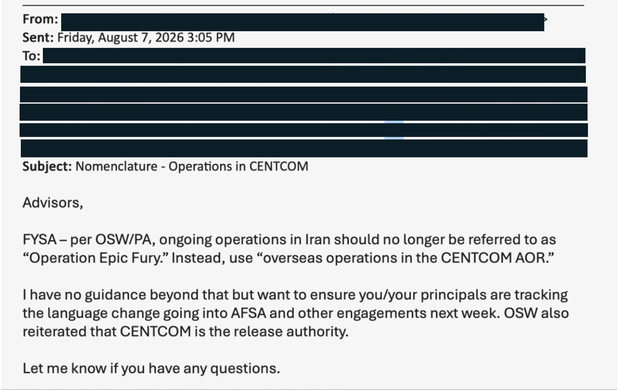
An Air Force email sent in August instructed personnel not to describe continuing U.S. military activity involving Iran as Operation Epic Fury, according to a document obtained by CBS News. The direction is notable because the Trump administration had already publicly presented the operation as finished months earlier. The Pentagon has now said the operation’s formal conclusion was May 5, creating a clear official end point while fighting between the United States and Iran continued at intervals afterward.
The email provides an internal marker of how the Pentagon wanted the conflict discussed. It did not merely revisit a past label: it told service members to stop applying that name to operations still under way. That distinction matters because a military operation can have an announced end date even when the security situation connected to it remains unsettled. In this case, the terminology instruction arrived roughly three months after the administration’s stated conclusion of Epic Fury.
Asked by CBS News about the matter, the Pentagon said on Wednesday that May 5 was the date on which Operation Epic Fury officially ended. Secretary of State Marco Rubio made a similar public declaration at the White House that day. He said, “The operation is over,” while describing Epic Fury as a completed phase. Rubio also said the administration was moving on to something he called Project Freedom, framing it as the next stage rather than a continuation under the earlier operation’s title.
The May 5 announcement followed a separate communication from President Donald Trump to Congress four days earlier. In that notice, Trump said that the hostilities had ended. Together, the congressional notification and Rubio’s remarks signaled that the administration considered the Epic Fury phase closed. Yet the formal date was not readily available afterward: for months, both the Pentagon and U.S. Central Command declined to provide the public with a definitive date for the operation’s end.
That earlier lack of a disclosed date left an important gap between public statements and the military’s formal record. The newly confirmed date helps place the August Air Force message in context. Rather than announcing a fresh conclusion, the email appears to have reinforced an existing official position inside the force. It also shows that the Pentagon was seeking to separate the name of a concluded operation from later activity connected to the Iran conflict.
The designation did not bring an end to all exchanges of fire. The United States and Iran have traded attacks intermittently since the Pentagon’s May 5 end date for Epic Fury. At the same time, the conflict has not been constant. There have been extended breaks in combat, including a ceasefire that began in early April. Those pauses and renewed exchanges complicate any simple reading of an operational end date as the end of confrontation on the ground or in the air.
For the administration, the difference between a closed operation and an ongoing confrontation is central to the account offered by Rubio. His reference to Project Freedom suggested a shift in the administration’s description of events, while the Air Force directive sought to make that shift visible in routine military language. The available information does not describe what name personnel were told to use instead, but it makes clear that Epic Fury was no longer the approved label for continuing operations involving Iran.
The Pentagon’s confirmation resolves one narrow question: the department now identifies May 5 as the official endpoint of Operation Epic Fury. It does not erase the broader ambiguity created by subsequent on-and-off fighting. What happens next will depend on whether the exchanges remain sporadic, whether another sustained pause takes hold, and how officials characterize any future U.S. action. For now, the August email underscores that the military’s vocabulary had to catch up with an operation the administration says was already over.
Source: CBS World
Related articles

Zelenskyy accuses Russia of using cluster warheads in deadly strikes
Russia launched the strikes on Ukraine less than a day after negotiations to end the war, which also involved the United States, ended in St. Petersburg.

Create AI images with your own API key
aixipi runs on desktop/web, uses your own model API balance, and avoids subscription lock-in.
Try aixipi →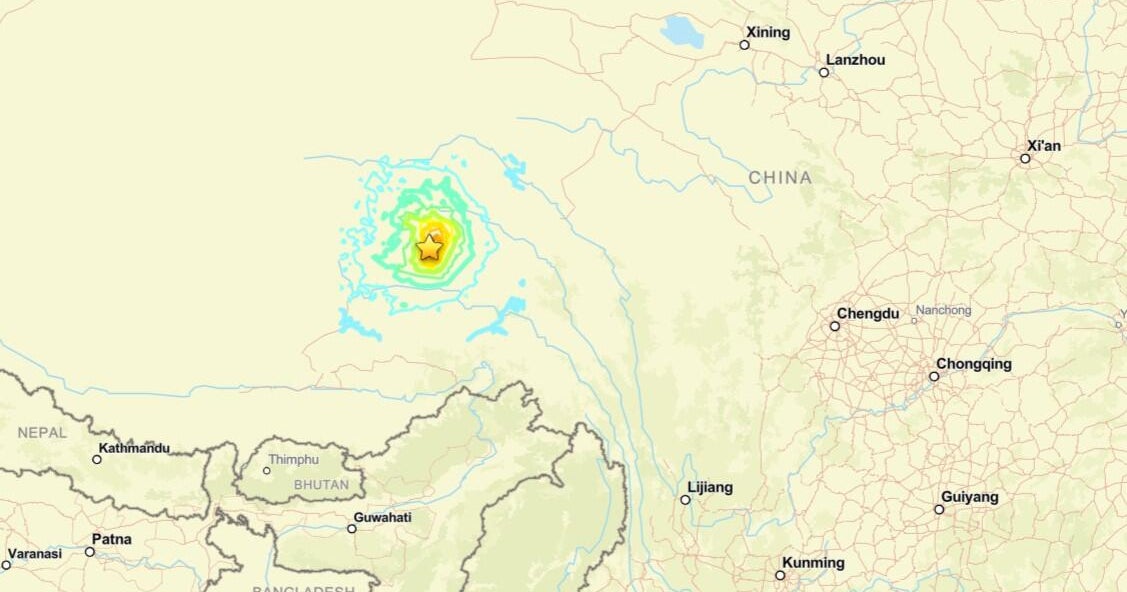
At least 16 dead when powerful 7.0 magnitude earthquake strikes Tibet
It was the biggest earthquake in the region in the last five years, China

See how Big Tech is transforming Spain's landscape
A drought-stricken region of northeast Spain has become a focus for American companies searching for locations to place their data centers.