
Mourners Placed an Ancient Sippy Cup in a Roman Toddler's Grave. It May Have Been Meant to Sustain the Child on the Journey to the Afterlife
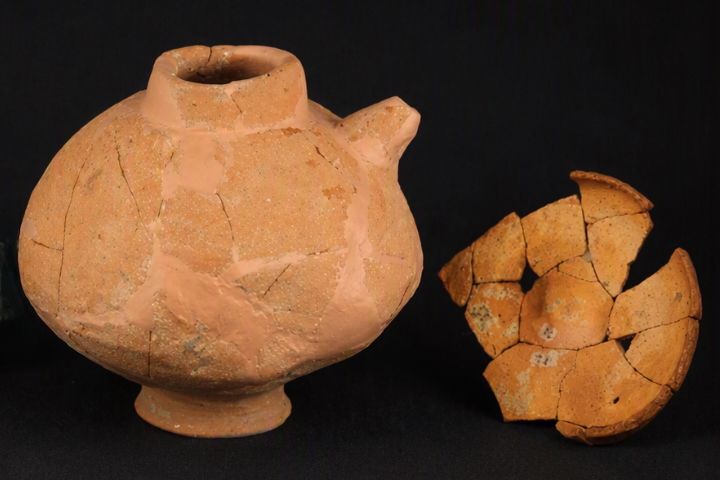
A small Roman drinking vessel recovered from a child’s burial in southwest England has been reconstructed and placed on public view for the first time. The object, called a tettina, has a spout and is often compared with a modern sippy cup. Its return from fragments offers a close look at the grief and ritual surrounding the death of a very young child nearly two millennia ago.
The cup was buried with a toddler estimated to have been between two and three years old. The grave dates to the second century C.E., when the area formed part of Roman Britain. Alongside the vessel, those arranging the burial left a small rooster figure made from enameled copper, creating an unusually personal collection of objects for an infant or young child’s grave.

Archaeologists from Cotswold Archaeology discovered the burial in 2011 during a long-running investigation of a substantial Roman cemetery in present-day Cirencester. The tettina did not emerge intact: it had broken into numerous pieces underground. Museum staff and specialists have since restored it, allowing visitors to see the object as a recognizable vessel rather than as scattered archaeological remains.
The cemetery itself underscores the scale of the Roman-era community once located there. Excavators identified 118 burials in which bodies had been interred, as well as eight cremation burials. The toddler’s grave was not located within the cemetery boundary, however. It lay beyond the enclosure, a placement that may raise questions about how very young children were treated in death, though the available discovery details do not establish why that location was chosen.
For the Corinium Museum, the restored cup is more than a domestic-looking artifact. Emma Stuart, the museum’s director, said death among infants was more common in the Roman period than it is now. In that setting, the vessel may have represented an attempt by mourners to care for a child beyond death rather than simply to place a familiar possession in the grave.
Stuart’s interpretation is that the tettina could have been intended to nourish the child’s spirit on its passage to the underworld. The spout would have made it practical for a toddler in life, while its inclusion in a burial gave it a different possible meaning after death. The interpretation cannot reveal the private beliefs of the people who attended this particular burial, but it provides a plausible explanation for why such a child-focused object was selected.
The rooster figurine adds another layer to the burial without resolving that uncertainty. Its survival beside the cup shows that mourners chose more than one object for the grave, rather than leaving the child with a single utilitarian item. Taken together, the finds point to a ceremony shaped by remembrance, material care and ideas about a destination beyond the grave.
Because the cup remained in pieces after its excavation, the story reached the public in stages. Archaeologists first documented the grave during the 2011 fieldwork, while the object’s restoration came later. Its display now makes a fragile find available for closer consideration and turns an excavation record into a visible account of loss within Roman Britain.
The discovery also illustrates both the value and the limits of burial evidence. Objects can preserve traces of choices made by mourners, but they do not supply a written explanation of every choice. Visitors can see the recovered tettina and the material evidence associated with the child, while the precise intentions of the family or community remain open to interpretation.
Source: Smithsonian Magazine
Related articles

Immerse Yourself in the Cosmos at Frank Lloyd Wright's Only Planetarium, Recently Restored to Its Former Glory in Florida
Completed in 1958, the domed building is located on the campus of Florida Southern College, home to 13 Wright-designed buildings, the world's largest single-site collection of the architect's work

Play Tractor online with friends — free
Real-time Sheng Ji / Tractor for 3–5 players, with complete bidding and trump rules across web, iOS and Android.
Play bidfive →
A Team of Astronomers Thinks They Have Identified the Exact Night Sky That Inspired Vincent van Gogh's 'Starry Night.' Not Everyone Is Convinced
Very few night skies seen from the south of France during the summer of 1889 would match the scene on van Gogh's canvas. A new study argues that it could have been July 22

'Pretty Boy' Floyd, One of the Most Notorious Outlaws of the Great Depression, Was Shot and Killed in an FBI Raid 92 Years Ago
Some Americans lauded the 30-year-old bank robber as a Robin Hood-esque folk hero. Others castigated him as a violent criminal whose misdeeds were emblematic of the troubled era

GTA 6 guides, updates and practical reference
Explore a Chinese GTA 6 guide library covering the release, map, characters, missions, vehicles and weapons.
Browse guides →
Create AI images with your own API key
aixipi runs on desktop/web, uses your own model API balance, and avoids subscription lock-in.
Try aixipi →