
Specialists Removed Three Thrilling, Century-Old Murals From the Walls of a French Monastery. Beneath, They Made 'a Discovery for the History of Art'
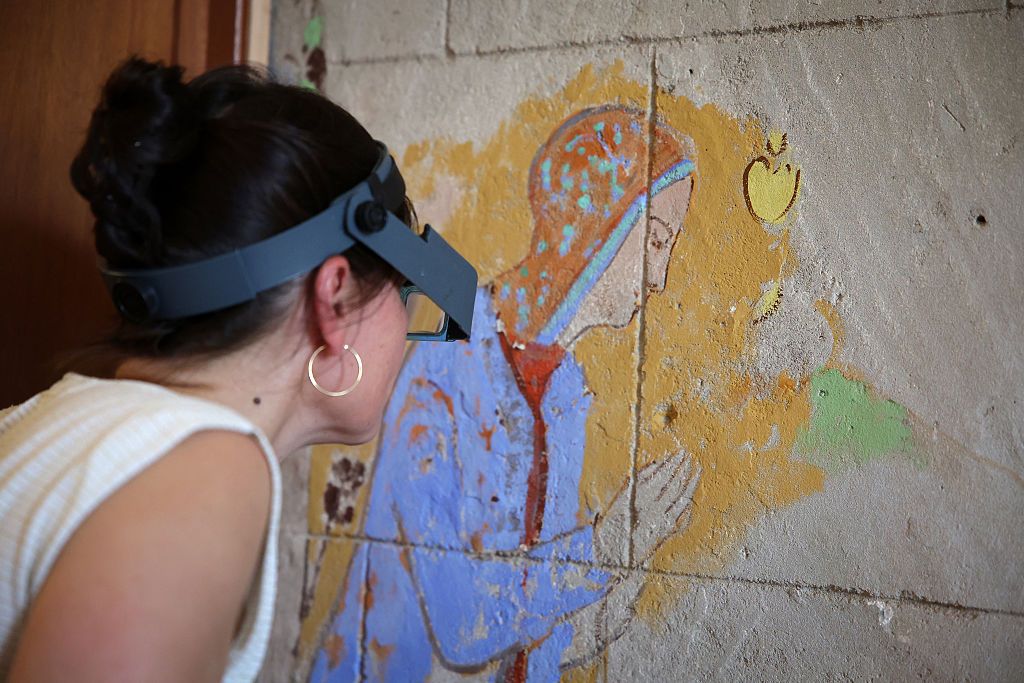
When conservators lifted three monumental paintings from the library of Abbaye de Fontfroide, they uncovered a second body of work left out of view for more than a century. The panels, painted by the French Symbolist Odilon Redon, had covered colored studies made directly on the walls behind them. The newly visible images provide an unexpected record of the artist’s working process inside the medieval monastery.
The discovery came during the first removal of the paintings since their installation in 1911. Conservation specialists took down the works so they could be lent to an exhibition in Paris. What began as preparation for a loan revealed drawings that visitors, scholars and caretakers had not previously been able to see. The temporary separation of the panels from the walls opened a part of the library that had effectively remained sealed since the early 20th century.
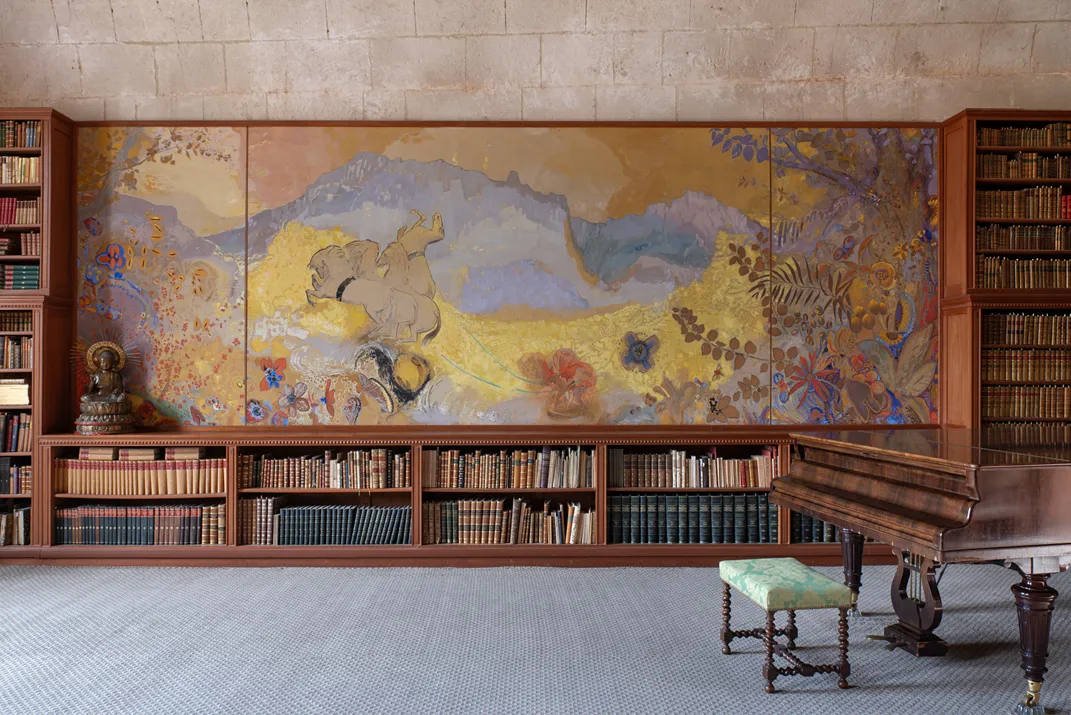
Fontfroide stands near Narbonne in southern France and began as a Cistercian abbey in the 11th century. Its library later became the setting for Redon’s ambitious decorative commission. The location matters to the discovery: the hidden marks were not preparatory sheets preserved elsewhere, but images placed by the artist on the building’s own surfaces. They link the painter’s work not only to a collection, but directly to the room for which the murals were created.
The three removable works form a carefully arranged ensemble within the room. Two long panels, Le Jour and La Nuit, extend beyond 20 feet apiece and sit among the library’s wooden shelving. Their scenes combine broad landscapes with people, animals and richly colored flowers, giving the interior a visual counterpoint to its ordered rows of books. The scale of the panels also helps explain why their original mounting had made the wall beneath them inaccessible.
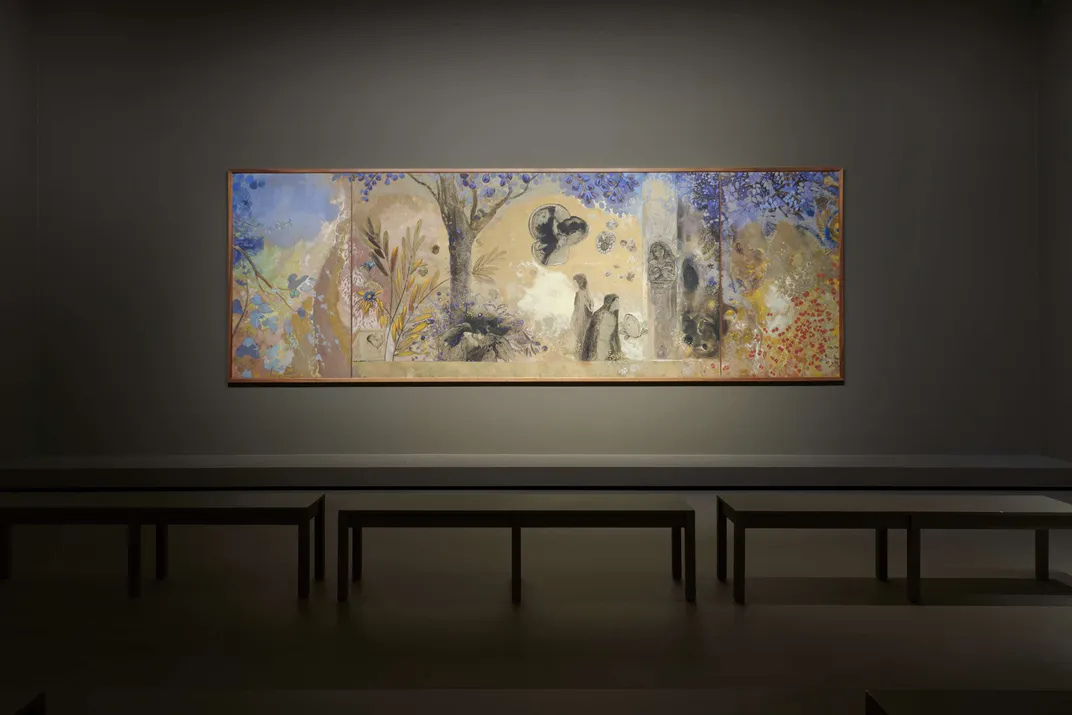
A third panel, Le Silence, occupies the space above a doorway. It depicts a figure that recalls a monk, holding a finger to the mouth, amid yellow flowers. Together, the titles and placement turn the library into more than a display room, connecting day, night and quiet with the abbey’s setting. The imagery combines religious associations with the imaginative, nature-filled vocabulary associated with Redon’s Symbolist art.
The wall drawings beneath the panels are also attributed to Redon. Their survival changes what can be studied at Fontfroide: the finished paintings can now be considered alongside work apparently made in the same architectural space. The juxtaposition offers researchers a rare opportunity to compare a formal decorative scheme with more immediate marks left on the wall, rather than relying only on works that were separately preserved or displayed.
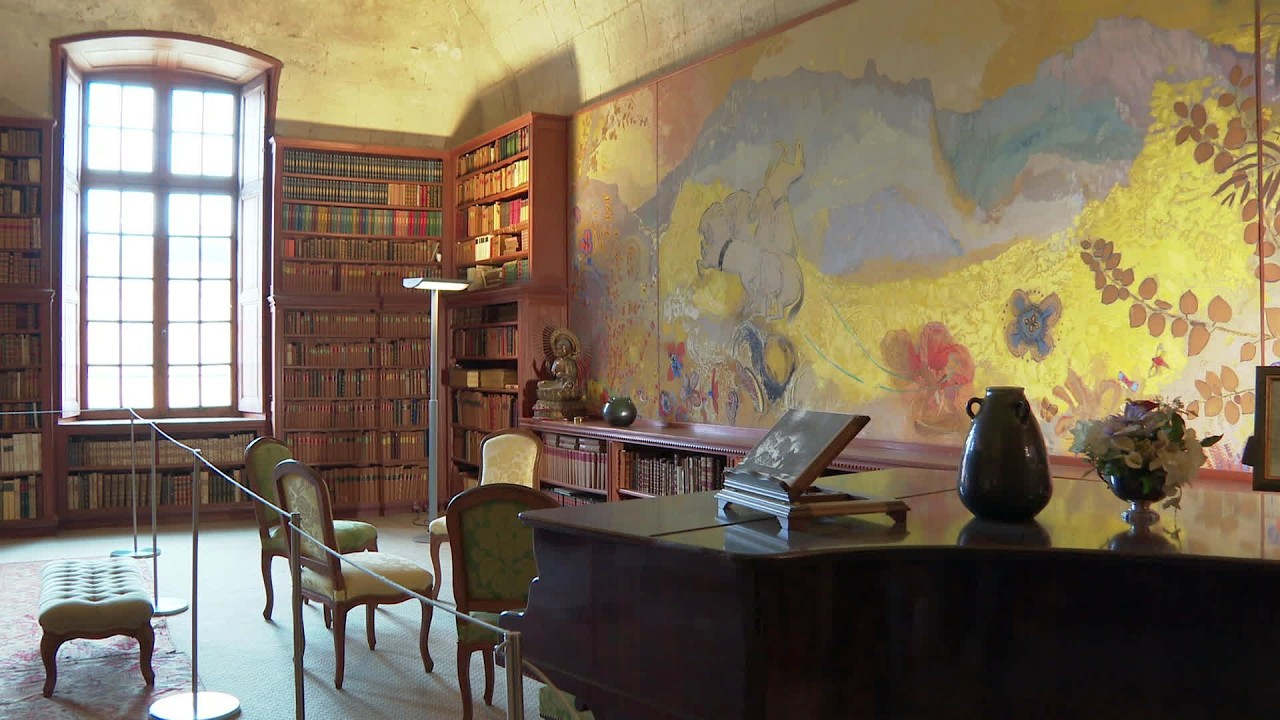
That relationship may help historians examine how an artist known for Symbolist imagery developed a project intended for a particular room. The sketches may provide clues about visual decisions made before or alongside the installation of the large panels. They also make the library itself a more important source for understanding the commission, because the building retains evidence of the artist’s activity beyond the surfaces normally seen by visitors.
The find also illustrates why moving an artwork can produce knowledge as well as risk. Panels that had remained in place for generations concealed part of the site’s artistic record. Their removal created access to areas normally closed off by the paintings, allowing conservators to identify the additional drawings without treating the historic installation as permanently altered. In this case, a loan intended to bring the murals to a new audience also revealed material that had stayed hidden at their original home.
There is still a limit to what the revelation alone can establish. The existence of colorful sketches on the wall does not, by itself, settle every question about their sequence, purpose or relationship to the panels. Further conservation and art-historical study will be needed to determine how the newly exposed work fits into Redon’s design for the library and how it should be protected after the paintings return from Paris.
For now, the Paris loan has given Fontfroide a newly expanded artistic story. The murals remain striking examples of early-20th-century decoration in an ancient religious complex, while the uncovered wall images add another layer to their history. Attention will turn to how the studies are documented, preserved and interpreted once the panels’ journey is complete.
Source: Smithsonian Magazine
Related articles
Divers Recover a Mysterious Cauldron That Had Been Hiding at the Bottom of an English River for Hundreds of Years
Nobody knows how the three-legged iron cauldron ended up in the River Wear. Weeks before Halloween, it finally returned to the surface

Play Tractor online with friends — free
Real-time Sheng Ji / Tractor for 3–5 players, with complete bidding and trump rules across web, iOS and Android.
Play bidfive →
Looted by Nazis and Recently Restituted, a Kaleidoscopic Kandinsky Painting Just Sold for Nearly $42 Million
"Das bunte Leben," the Russian artist's dreamlike panorama, bridges folklore and early modernism. The sale follows a 2023 ruling concluding that the work was seized from its rightful Dutch Jewish owners
An Italian Farmer Found Some Unknown Seeds in His Attic and, With Nothing to Lose, Planted Them. The Result Was Almost Biblical
When a seven-eared stem emerged from the ground, it seemed like a miracle. What Claudio Grossi had unearthed was an ancient grain that proved to be an answer to some modern problems

GTA 6 guides, updates and practical reference
Explore a Chinese GTA 6 guide library covering the release, map, characters, missions, vehicles and weapons.
Browse guides →
Create AI images with your own API key
aixipi runs on desktop/web, uses your own model API balance, and avoids subscription lock-in.
Try aixipi →