
This New Brain Map Shows Every Nerve Cell in an Adult Male Fruit Fly's Central Nervous System. Here's Why That Matters
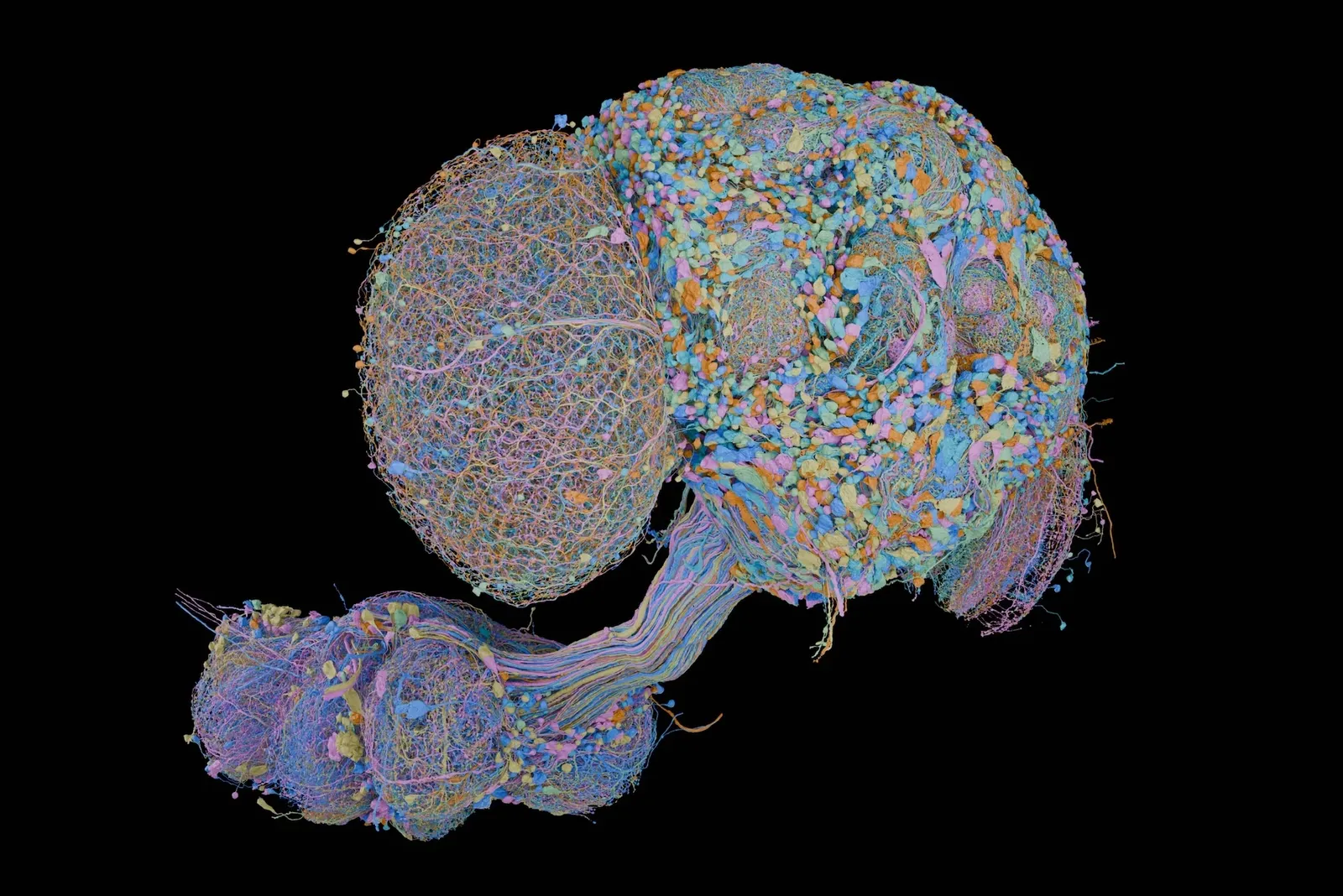
Scientists have completed a detailed digital wiring map of the central nervous system of an adult male fruit fly, cataloguing 166,700 nerve cells and the millions of links that connect them. The resource covers both the fly's brain and its nerve cord, a structure that performs a role comparable to the spinal cord in people. Together, those components form the insect's central nervous system and offer researchers an unusually complete view of how signals can travel through it.
The achievement is known as a connectome: a map designed not simply to show where cells sit, but to record how they are connected. Its three-dimensional digital form lets researchers follow individual routes through the nervous system, from cells receiving sensory information to cells involved in a response. For a creature whose brain is roughly as small as a poppy seed, the resulting dataset is strikingly expansive.

The male map arrives alongside an earlier completed connectome for the brain of an adult female fruit fly. Having comparable reference maps for the two sexes gives scientists a way to examine circuitry rather than treating a fly nervous system as a single, generic model. The newly released work extends that comparison beyond the brain by including the nerve cord, making it possible to study pathways that connect brain activity with the rest of the animal.
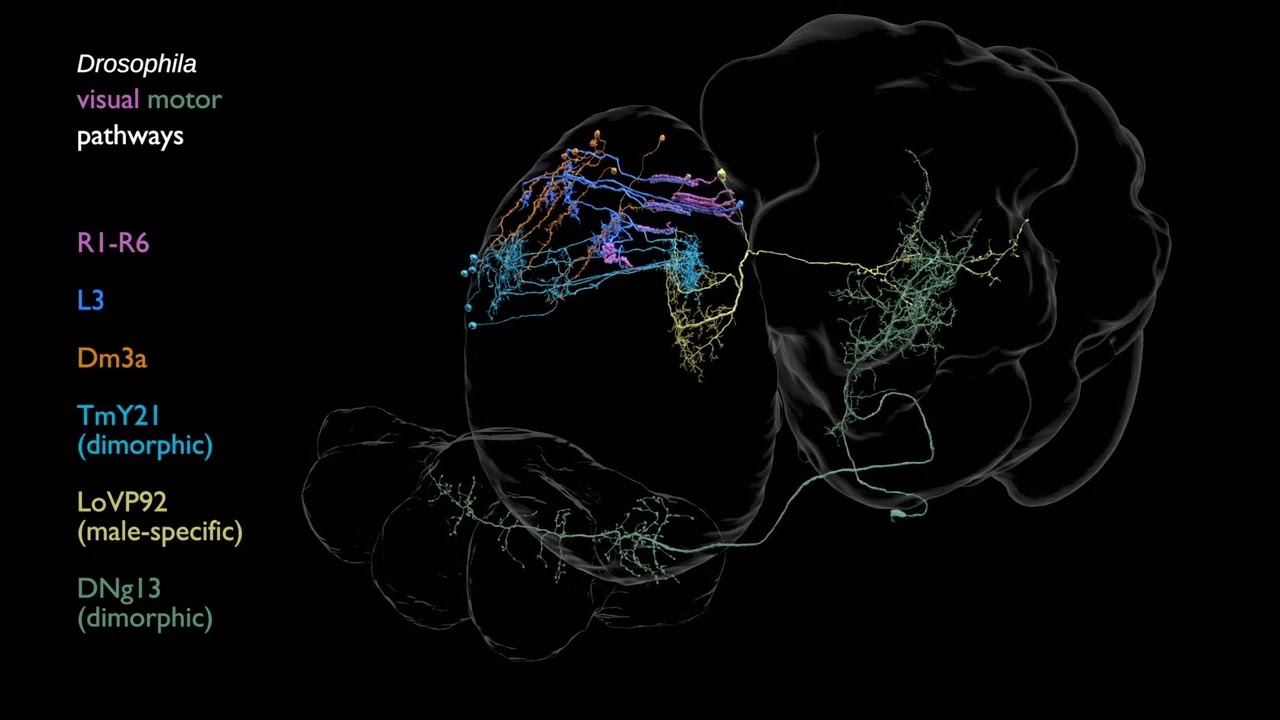
That broader reach matters because behavior is not generated in one isolated region. A fly has to detect information from its environment, process it through networks of neurons and ultimately produce an action. With the new map, investigators can trace candidate routes between incoming sensory signals and behavioral outputs with much greater precision. The diagram does not by itself explain every decision a fly makes, but it provides a detailed structural framework for testing how a particular response might be assembled.
The map has also begun to support research into the influence of genes on neural circuits. Genes can affect the development and operation of the cells and connections that make up a nervous system. A reference wiring diagram allows researchers to place those effects in anatomical context, asking which circuits may be altered and how changes could relate to an observed behavior. That approach links genetic questions to identifiable networks rather than to the brain in the abstract.
Comparisons between male and female flies are another early use. Biological sex can be associated with differences in circuits and behavior, and paired maps make it easier to look for those distinctions at the level of cells and connections. The value is not limited to compiling a list of differences. Researchers can use the diagrams to explore which routes vary, where they converge and how those patterns may shape the way flies receive information or act on it.
Fruit flies have long been important laboratory organisms, in part because their nervous systems are more manageable to investigate than those of larger animals. Yet their brains still carry out the essential tasks of sensing, processing and directing behavior. A fully charted system can therefore serve as a practical testing ground for ideas about neural organization. Lessons from it are not a one-to-one blueprint for the human brain, but the wiring resource may help scientists frame questions about how far more complex human neural networks are arranged.
There is an important limit to what a connectome can deliver. A map records the physical pattern of cells and their connections; it is not a live readout of every signal, chemical state or experience occurring in an animal. Interpreting a route will still require experiments that examine activity, genes and behavior. In that sense, the work is a foundation for future studies rather than a final explanation of how a brain produces thought or action.
The map and findings already enabled by it were reported on September 3 across four scientific papers. Three appeared in Cell, while a fourth was published in Current Biology. The next phase will be determined by how researchers use the digital models: to follow specific sensory-to-action pathways, test genetic effects on circuits and sharpen comparisons between the male and female fly nervous systems. Each use can turn an immense inventory of connections into more focused questions about how neural wiring supports behavior.
Source: Smithsonian Magazine
Related articles

Immerse Yourself in the Cosmos at Frank Lloyd Wright's Only Planetarium, Recently Restored to Its Former Glory in Florida
Completed in 1958, the domed building is located on the campus of Florida Southern College, home to 13 Wright-designed buildings, the world's largest single-site collection of the architect's work

Play Tractor online with friends — free
Real-time Sheng Ji / Tractor for 3–5 players, with complete bidding and trump rules across web, iOS and Android.
Play bidfive →
A Team of Astronomers Thinks They Have Identified the Exact Night Sky That Inspired Vincent van Gogh's 'Starry Night.' Not Everyone Is Convinced
Very few night skies seen from the south of France during the summer of 1889 would match the scene on van Gogh's canvas. A new study argues that it could have been July 22

'Pretty Boy' Floyd, One of the Most Notorious Outlaws of the Great Depression, Was Shot and Killed in an FBI Raid 92 Years Ago
Some Americans lauded the 30-year-old bank robber as a Robin Hood-esque folk hero. Others castigated him as a violent criminal whose misdeeds were emblematic of the troubled era

GTA 6 guides, updates and practical reference
Explore a Chinese GTA 6 guide library covering the release, map, characters, missions, vehicles and weapons.
Browse guides →
Create AI images with your own API key
aixipi runs on desktop/web, uses your own model API balance, and avoids subscription lock-in.
Try aixipi →