
U.K. anti-migrant protests condemned as "thuggish and intimidating"
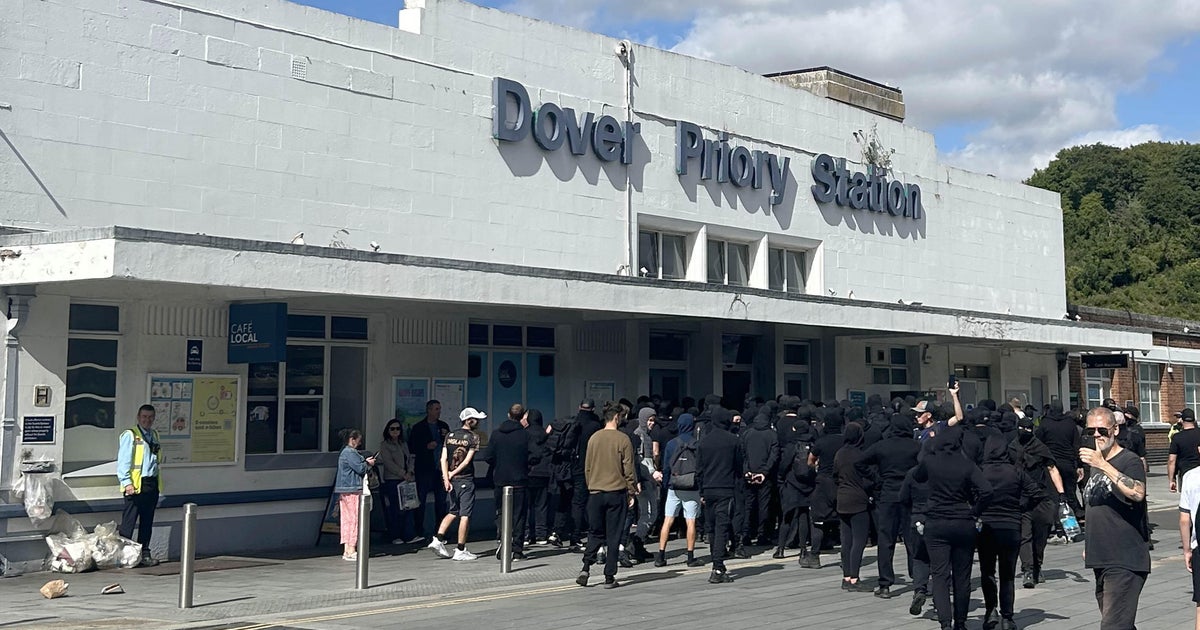
Masked opponents of migration disrupted access to England’s Port of Dover on Saturday, stopping vehicles on roads serving the ferry terminal and attempting to prevent buses carrying recently arrived migrants from moving through. The action, which unfolded at one of the world’s busiest passenger sea crossings, was met with broad criticism. Detractors described the tactics as thuggish and intimidating, arguing that the protest moved beyond a public display of opinion by interfering with travelers, freight and people arriving in the country.
Hundreds of demonstrators took part in the Dover action over the weekend. Many concealed their faces with balaclavas, wore black clothing and carried English or British flags. Their presence along the approaches to the port brought traffic to a halt. The gathering added to a sequence of demonstrations around Britain that have become more confrontational, placing a politically charged argument over migration directly in the path of routine transport and border travel.
Protesters voiced their demands with chants including “stop the boats” and “Christ is king.” Those slogans brought together opposition to migrant arrivals by sea with a religious message, while the flags and masked appearance gave the demonstration a highly visible national character. The available account does not establish a single organization, a detailed set of demands or the identities of those involved, but it does show that the protest centered on stopping arrivals and obstructing vehicles linked to them.
Dover’s ferry facilities are a major point of passage for passengers and commercial goods, so the blockage had effects beyond the immediate protest site. Road traffic backed up for about four miles after the routes toward the terminal were closed off. People intending to use ferries were disrupted, and freight movements were affected as well. The resulting delays illustrated how quickly a protest at a transport bottleneck can spread its impact to families, drivers, carriers and businesses with no direct role in the dispute.
The attempted obstruction of buses carrying newcomers became a central feature of the condemnation. Demonstrations can communicate anger or political demands, but efforts to impede specific vehicles and the people inside them raise more immediate questions about safety, access and intimidation. Critics from across the political and public landscape objected to that approach, according to the account. The criticism focused not only on the disruption to Dover’s roads, but also on the confrontational method chosen by the participants.
The incident reflects a wider tension in Britain over migrants arriving by small boats, a subject that has repeatedly produced sharply opposed public reactions. In Dover, that national argument was concentrated at a port closely associated with cross-Channel movement. The protest’s location made its message impossible to separate from practical consequences: vehicles could not move normally, ferry users faced delays and freight traffic was interrupted. It also showed how an issue debated in politics and public life can become an immediate local disruption.
There is an important distinction between the political sentiment expressed by protesters and the conduct reported at the port. The account records chants and flags that signaled opposition to migrant arrivals, but it also records road blockages and an effort to stop buses. Supporters of tougher migration controls may share concerns about arrivals without necessarily endorsing tactics that immobilize a busy transport route. Conversely, the widespread backlash indicates that many observers regarded the methods at Dover as unacceptable regardless of the underlying debate.
For passengers and haulage operators, the immediate concern was whether access to the terminal could be restored and delays contained. For officials and communities, the larger question is whether demonstrations over migration will continue to escalate in ways that put public roads and transport services under pressure. The Dover protest did not merely create a symbolic confrontation; it demonstrated the operational cost of blocking a key gateway. Any further actions of this kind are likely to be judged both by their political message and by their effect on people trying to travel or work.
The next developments to watch are whether organizers or participants seek further demonstrations, whether authorities take steps to protect access to major transport hubs, and whether the public response alters the tone of the wider migration debate. The available account establishes a weekend of disruption at Dover and strong disapproval of its tactics, rather than a resolution of the underlying dispute. What is clear is that the protest imposed costs on travelers and freight traffic while turning a port approach into the latest flashpoint in a growing series of confrontations.
Source: CBS World
Related articles

Zelenskyy accuses Russia of using cluster warheads in deadly strikes
Russia launched the strikes on Ukraine less than a day after negotiations to end the war, which also involved the United States, ended in St. Petersburg.

Create AI images with your own API key
aixipi runs on desktop/web, uses your own model API balance, and avoids subscription lock-in.
Try aixipi →
At least 16 dead when powerful 7.0 magnitude earthquake strikes Tibet
It was the biggest earthquake in the region in the last five years, China

See how Big Tech is transforming Spain's landscape
A drought-stricken region of northeast Spain has become a focus for American companies searching for locations to place their data centers.